
From Curiosity to Capability: AI’s Role in Rental Housing
From Curiosity to Capability: AI’s Role in Rental Housing

Learn More About How AI has Reshaped the Rental Housing Industry.
By Eri Bajomo |
Artificial intelligence (AI) has been one of the most discussed technologies across the business landscape in recent years, and the rental housing industry is no exception. Yet the conversation surrounding AI today looks markedly different from the one that took place just two years ago.
When the Research Department at the National Apartment Association (NAA) first explored artificial intelligence in rental housing in 2024, the industry was still in the early stages of understanding its potential. Interviews with industry leaders and survey respondents revealed strong interest in AI's ability to improve efficiency, support innovation and streamline operations. At the time, however, adoption remained relatively limited, policies were largely undeveloped, and organizations were still evaluating where AI fit within their business strategies.
Since, AI has quickly shifted from an emerging concept to operational reality. Findings from multiple NAA research initiatives conducted between 2024 and 2026 – including studies on technology adoption, operational resilience, business performance and industry sentiment – suggest that rental housing organizations are increasingly incorporating AI into everyday workflows. However, adoption remains uneven. Many operators are using AI for communication, marketing, workflow management and information gathering, while others still report not using AI at all. Largely, most organizations are still navigating concerns around data quality, cybersecurity, compliance, workforce readiness and responsible implementation. For many, questions about governance and policies and procedures remain as important as the technology itself.
From Experimentation to Operational Application
One of the clearest themes emerging from recent research is that organizations continue to focus AI and automation efforts on functions where technology can improve efficiency, streamline workflows and enhance interactions with residents.
In 2025, marketing and leasing, along with resident communications, were the areas where respondents reported the greatest AI impact. More recent findings point to similar patterns, while also showing gradual expansion into maintenance scheduling, reporting and analytics. Rent collection and payment reminders also emerged as a notable operational application in 2026. Overall, these findings suggest that many early AI use cases are concentrated on customer-facing functions and administrative tasks where organizations can quickly capture efficiency gains.
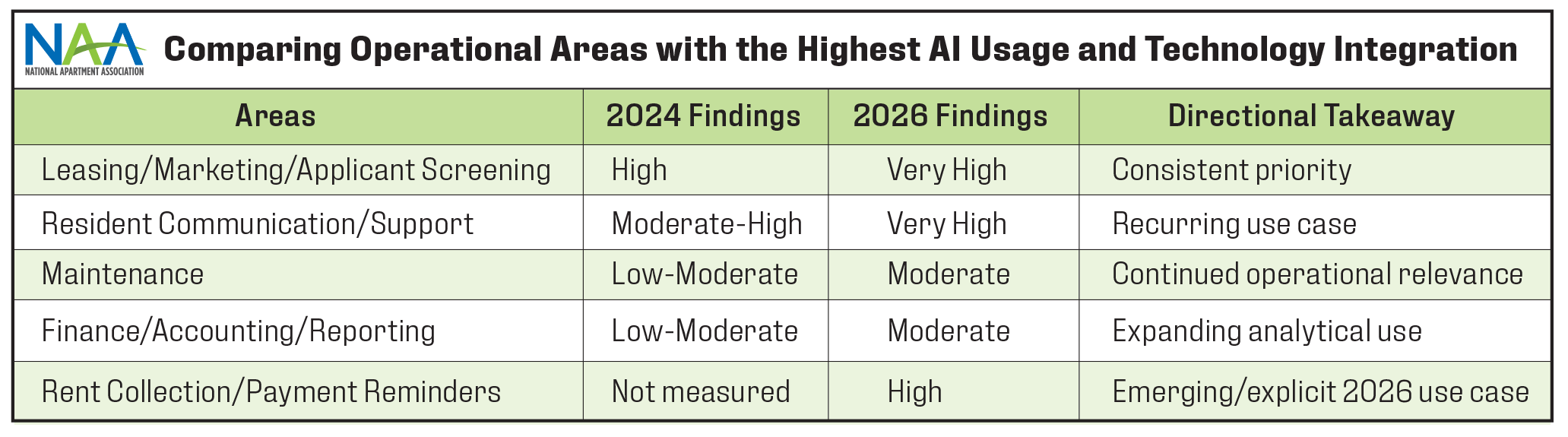
Taken together, the findings suggest that operators are not moving away from earlier use cases but building on them. Across studies, leasing-related functions, resident communication and maintenance remain among the most visible areas where operators see opportunities to improve efficiency, automate routine tasks and support day-to-day activities. While the specific technologies may continue to evolve, the underlying objective appears largely unchanged: Using technology to help teams work more effectively, improve service delivery and reduce operational friction.
Adoption Has Increased, but Expectations Have Become More Realistic
One of the clearest shifts emerging from recent research is the growing normalization of AI tools across business functions. If 2024 was defined by exploration, 2025 marked a turning point toward broader adoption.
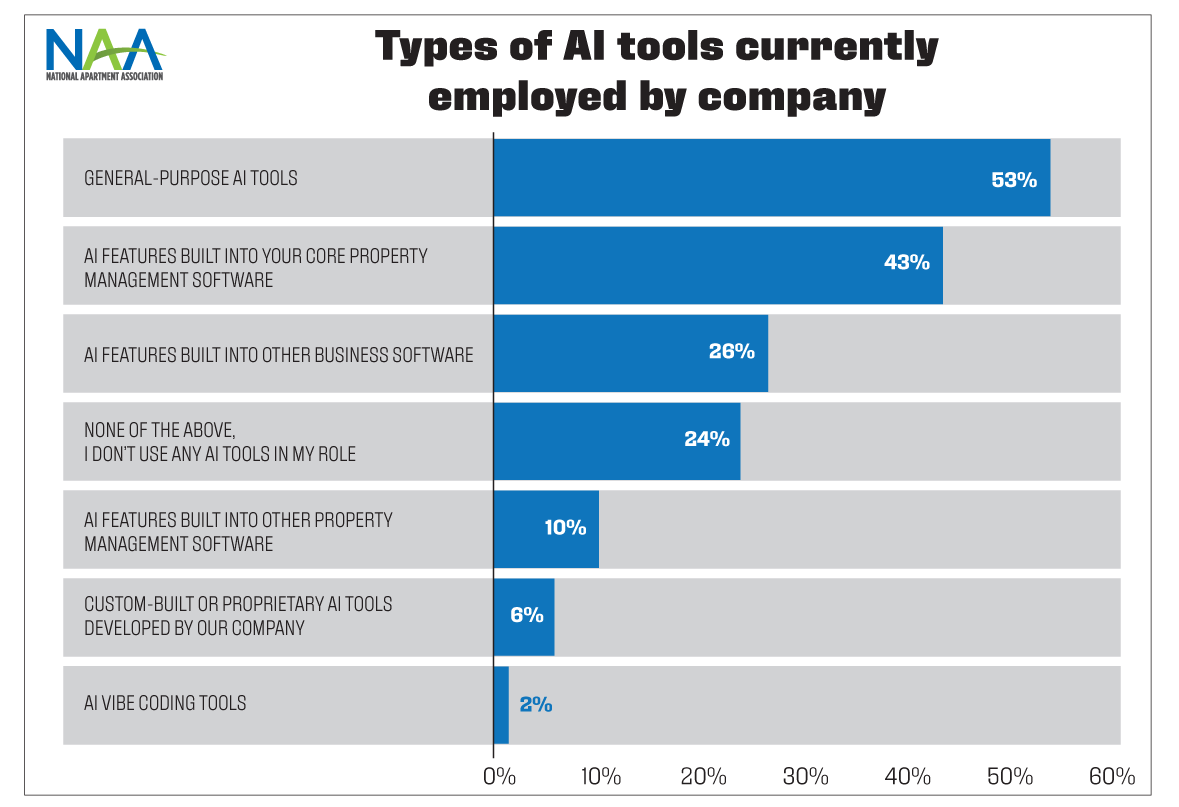
The 2025 research shows that more than half of respondents reported using general-purpose AI tools readily available for public use, while many others reported using AI capabilities integrated directly into property management software and business productivity platforms to support day-to-day activities. AI has moved beyond niche experimentation and into the mainstream workflows of many organizations.
At the same time, respondents provided a more nuanced assessment of AI's value than much of the public discourse surrounding the technology. Nearly 80% of respondents reported that AI had improved organizational performance, yet most described those benefits as incremental rather than transformational. The majority characterized AI as "moderately helpful," while far fewer described it as revolutionary.
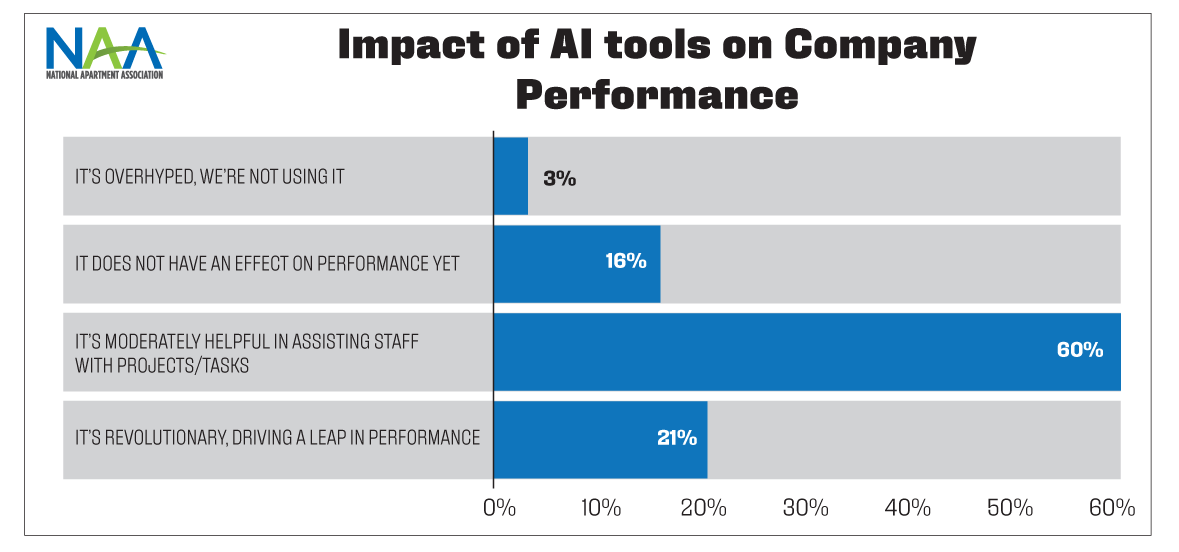
The findings suggest that operators are becoming more sophisticated in how they evaluate AI. Rather than viewing it as a standalone solution, organizations increasingly appear to see AI as one tool within a broader technology ecosystem: Valuable for improving productivity and efficiency but not a substitute for strong processes, experienced staff or sound business strategy. The common thread connecting these priorities is the pursuit of greater operational effectiveness in an increasingly complex business environment.
As Adoption Has Evolved, So Have the Challenges
One of the most consistent findings across NAA's research is that concerns surrounding artificial intelligence have persisted even as adoption has expanded. While the specific issues raised by respondents vary across studies, several themes – integration, workforce readiness, accuracy and governance – appear repeatedly throughout the research.
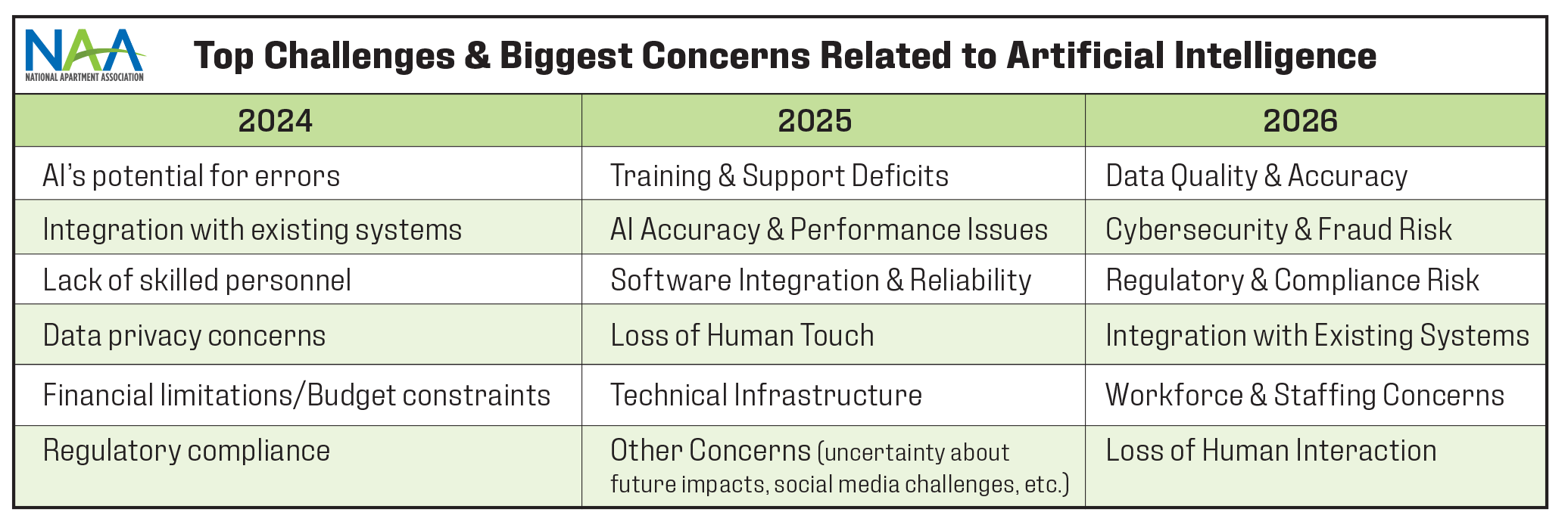
Early research highlighted concerns such as AI's potential for errors, integration with existing systems, privacy considerations, budget constraints and the availability of skilled personnel. By 2025, respondents were increasingly discussing training and support deficits, software reliability, technical infrastructure and concerns about preserving the human element in resident interactions. More recent findings point to data quality and accuracy, cybersecurity risks, compliance considerations, workforce implications and continued integration challenges.
Rather than suggesting that one set of concerns has replaced another, the findings indicate that organizations are developing a more sophisticated understanding of both the opportunities and limitations associated with AI. As adoption expands, the conversation is becoming less about whether AI can be used and more about how it can be implemented, managed and governed effectively.
Governance Is Becoming the Next Competitive Advantage
Perhaps the most important theme to emerge from the research is the growing importance of governance. When NAA Research first examined AI usage in 2024, more than half of respondents indicated they were waiting for industry guidance and best practices regarding AI policies. Only a minority reported having formal governance frameworks, written guidance or structured training programs in place.
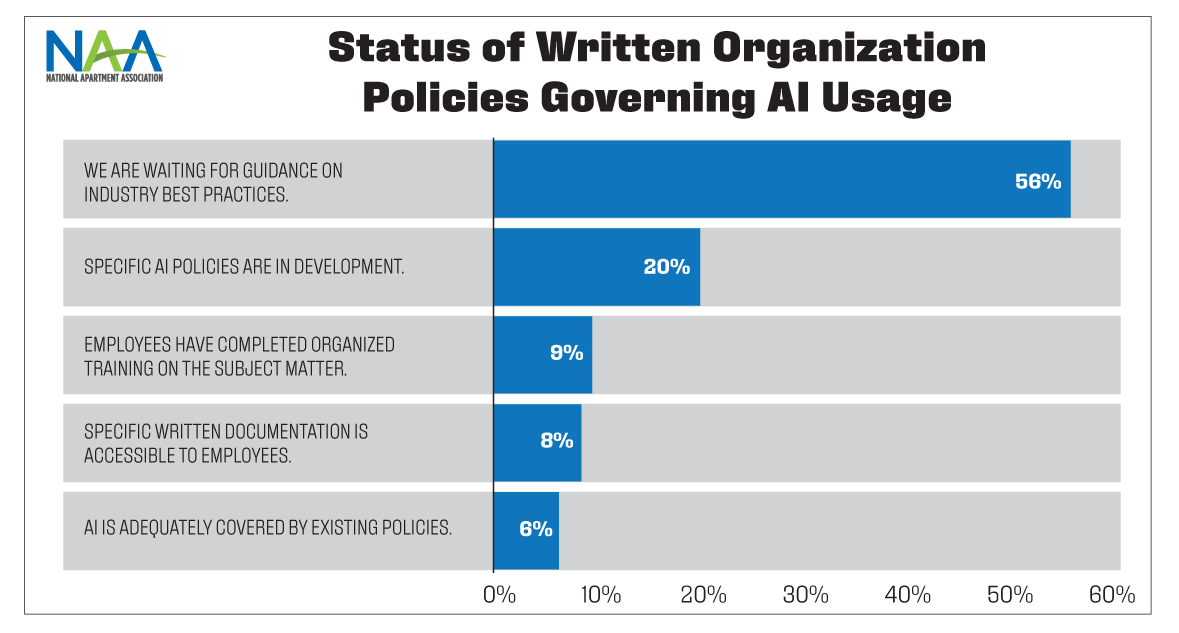
While adoption has accelerated since then, newer findings suggest that governance-related issues have become increasingly central to the conversation. Concerns regarding cybersecurity, compliance, data quality and AI operational oversight are becoming more prominent as organizations move from pilot projects to implementation.
The challenge facing many organizations is no longer whether to adopt AI. It is determining how to govern it effectively while balancing innovation, accountability and risk.
Broader Technology Investment Is Rising, but Implementation Challenges Persist
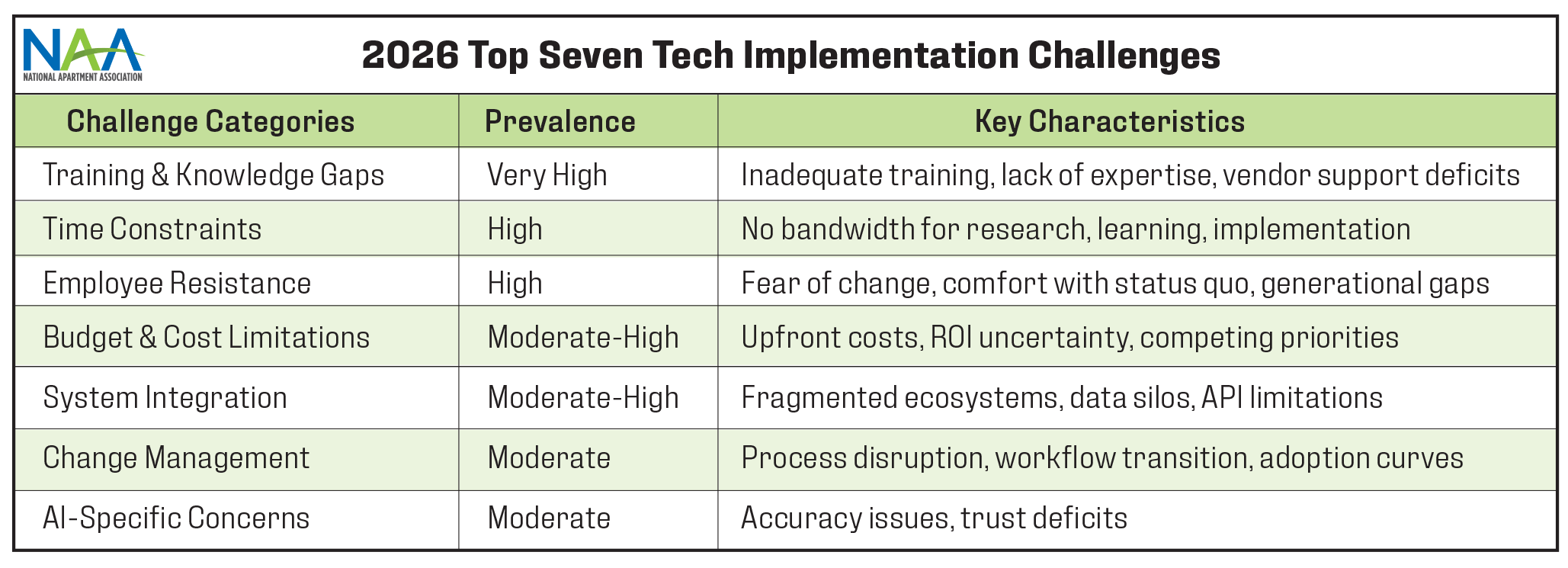
Across every study reviewed, one theme surfaced repeatedly: The human element remains central to successful technology implementation. Training gaps appeared in the 2024 research. Respondents identified training and support deficits in 2025. By 2026, training and knowledge gaps remained the most frequently cited technology implementation challenge, accompanied by time constraints, employee resistance, budget limitations, system integration issues and change management hurdles.
The contrast between technology priorities and implementation challenges is particularly telling. Operators are increasingly focused on AI adoption, process automation, operational efficiency and digital transformation initiatives. However, the barriers preventing progress are rarely technological. Instead, organizations report struggling with workforce readiness, limited time for research and implementation, resistance to change, fragmented systems and uncertainty about the value and risks associated with new technologies.
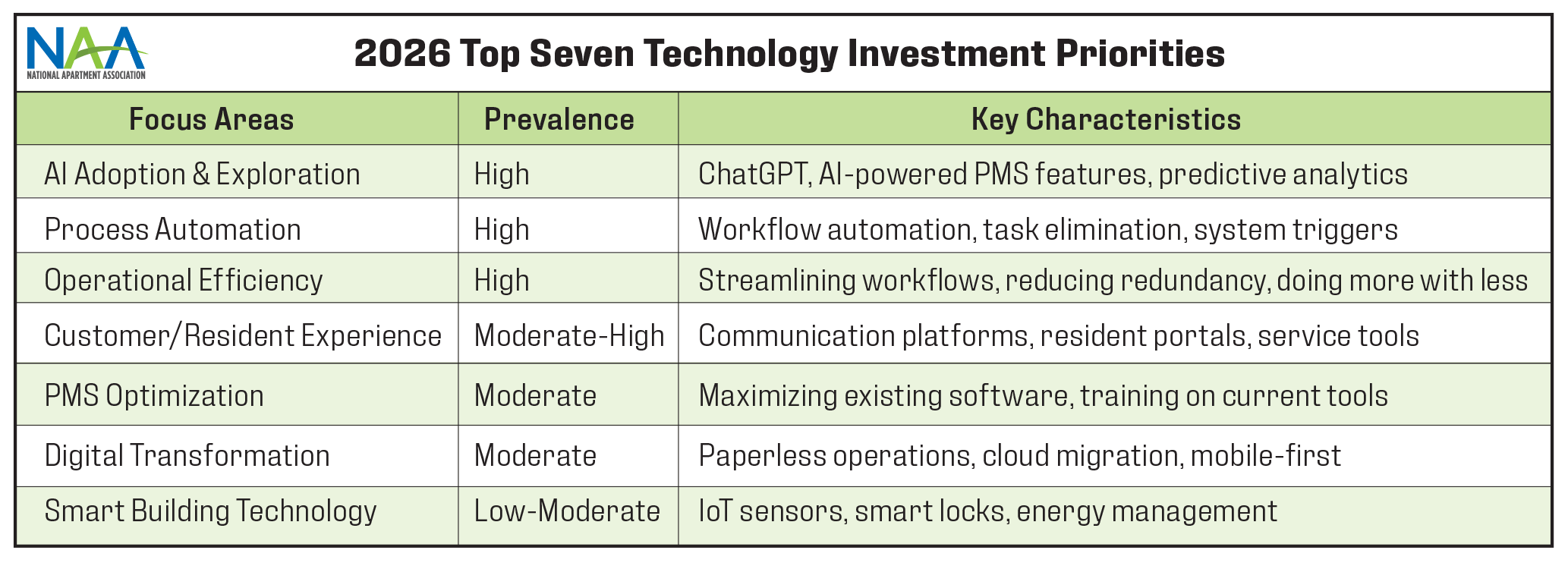
The findings suggest that successful technology adoption depends on far more than selecting the right software or platform. Organizations can invest in AI-powered tools, automate workflows and modernize operations, but realizing value from those investments requires employee buy-in, training, integration across systems and effective change management. Even AI accuracy issues and trust in AI-generated outputs highlight the importance of human oversight and organizational preparedness.
Taken together, the research suggests that organizations are increasingly viewing AI as a component of larger digital transformation efforts rather than a standalone technology initiative. The future of AI and digital transformation in rental housing may depend as much on organizational capability as technological capability. As operators continue investing in new technologies, the greatest competitive advantage may not come from adopting tools first, but from building the people, processes and governance structures needed to use them effectively.
Looking Ahead
The conversation has moved beyond speculation about whether artificial intelligence will affect the industry. Research increasingly points to a future where AI, automation and data-driven technologies become embedded in routine operations. At the same time, organizations continue to wrestle with important questions regarding governance, workforce development and responsible implementation.
What emerges from the research is not a story of technology replacing people, but one of organizations learning how to leverage new tools while balancing efficiency, risk and human expertise. As the industry continues to evolve, the companies that achieve the greatest value from AI may not be those that adopt it fastest, but those that develop the structures, policies and capabilities necessary to use it effectively.
About the Research
This article draws on findings from several NAA research initiatives conducted between 2024 and 2026 examining artificial intelligence, operational technology, workforce readiness, business performance and technology adoption in rental housing. Because these studies varied in purpose, timing and methodology, findings are presented directionally to identify recurring themes and emerging industry patterns rather than as a single combined dataset.