
Resident Retention: Why the Renewal Process Starts Long Before the Renewal Notice
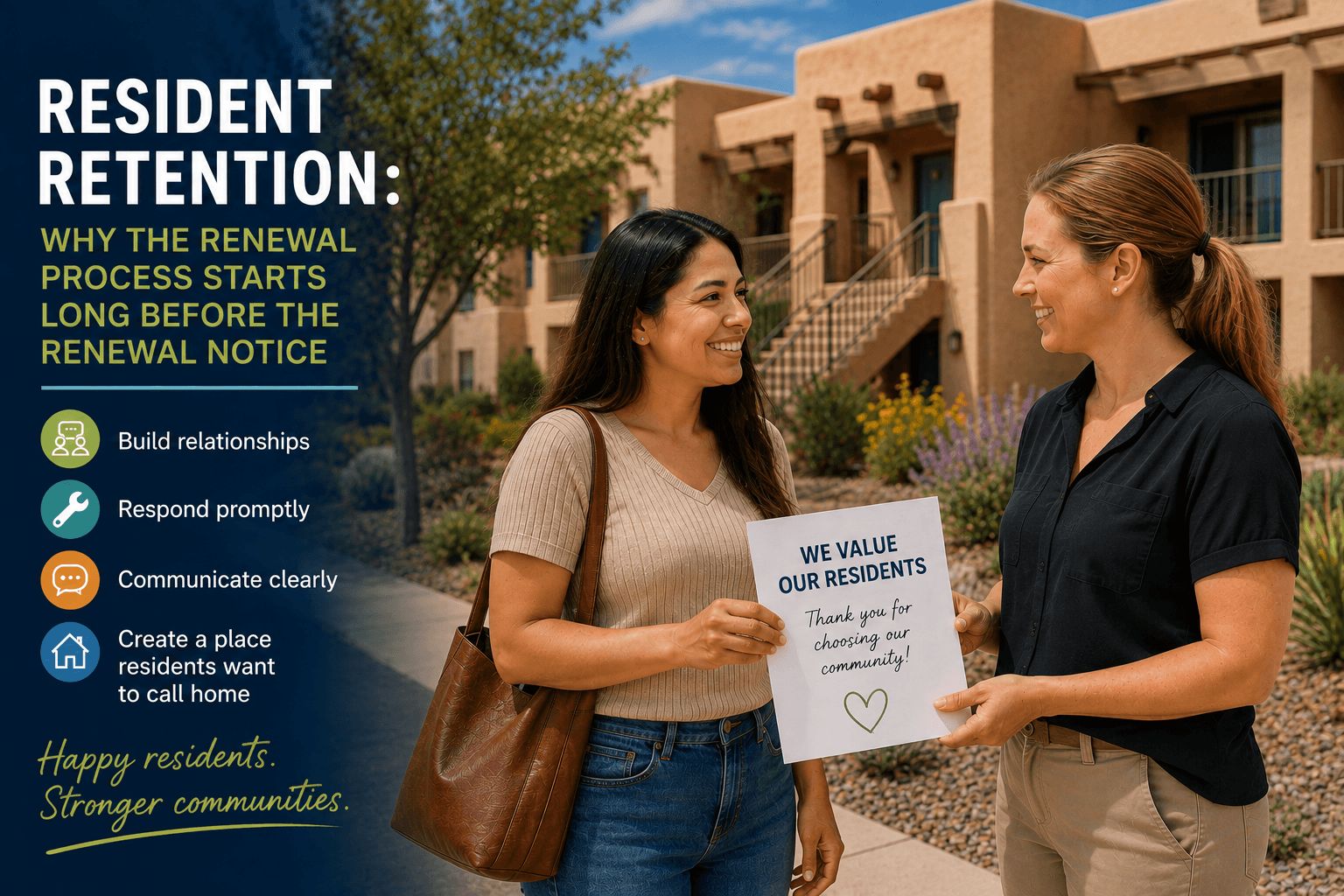 Resident Retention: Why the Renewal Process Starts Long Before the Renewal Notice
In multifamily housing, it is easy to think of resident retention as something that happens 60 or 90 days before a lease expires. A renewal notice goes out, a new rental rate is offered, and the resident decides whether to stay or move.
In reality, that decision often begins months earlier.
Every maintenance request, interaction with the office, community update, billing question, and property improvement contributes to how a resident feels about where they live. By the time a renewal offer arrives, many residents have already formed an opinion about whether they want to stay.
For New Mexico apartment communities, where operating costs continue to rise and attracting qualified residents can require significant time and expense, strong resident retention can be an important part of operating a successful property.
Retention Starts on Day One
A resident's experience begins before they receive their keys. The leasing process, application experience, communication before move-in, condition of the apartment, and move-in process all create a first impression.
A smooth move-in helps establish trust between the resident and the management team. Conversely, unresolved maintenance issues, poor communication, or unexpected charges at move-in can start the relationship on the wrong foot.
Consider creating a consistent move-in process that includes clear explanations of community policies, contact information, maintenance procedures, payment expectations, utilities, parking, and other frequently asked questions.
The goal should be simple: residents should know what to expect and where to go when they need assistance.
Maintenance May Be Your Most Important Retention Tool
Residents may love the location, amenities, or layout of their apartment, but few things affect their experience more directly than maintenance.
The important factor isn't necessarily that nothing ever breaks. In an apartment community, equipment will inevitably require repair. What residents remember is how management responded when something went wrong.
Was the maintenance request acknowledged? Did someone arrive when expected? Was the problem resolved? If there was a delay, did anyone communicate with the resident?
Even when a repair cannot be completed immediately, communication can make a significant difference. A resident who understands that a part has been ordered and knows when to expect the next update is likely to have a very different experience than someone who hears nothing for several days.
Tracking repeat maintenance requests can also reveal larger problems. If residents repeatedly report the same plumbing, HVAC, appliance, or building issue, addressing the underlying cause may improve resident satisfaction while reducing long-term maintenance expenses.
Communication Matters
Residents generally don't expect perfection. They do expect communication.
Whether management is announcing a water shutoff, explaining a repair delay, reminding residents about a community policy, or responding to a complaint, timely and professional communication helps build credibility.
This is especially important when something goes wrong.
A short update acknowledging an issue and explaining what is being done can prevent frustration from escalating. Silence often creates the opposite result.
Property teams should also consider how they communicate. Email, resident portals, text messaging, phone calls, and written notices each have their place. Important communications should be clear, professional, consistent, and documented when appropriate.
Consistency Builds Trust
One of the quickest ways to create frustration within an apartment community is inconsistent enforcement of policies.
If parking rules, late fees, noise policies, pet requirements, or other community standards appear to be enforced differently from one resident to another, residents may perceive the process as unfair.
Consistency is also important from a Fair Housing perspective. Policies and procedures should be applied uniformly while still allowing management to appropriately evaluate reasonable accommodation or modification requests and other circumstances protected by law.
Clear policies, good documentation, and regular employee training can help property teams remain consistent.
Small Problems Can Become Renewal Problems
A resident may never formally complain about every frustration.
A gate that has been broken for weeks, landscaping that has deteriorated, overflowing dumpsters, poor exterior lighting, recurring noise issues, or an unanswered email may seem relatively minor individually. Over time, however, these experiences accumulate.
When renewal time arrives, management may see only one question:
Will you renew your lease?
The resident may be thinking about the previous twelve months.
Regular property walks, resident feedback, maintenance data, online reviews, and conversations with onsite staff can help management identify recurring concerns before they become reasons for residents to leave.
Know Why Residents Are Leaving
Not every move-out can, or should, be prevented.
Residents purchase homes, relocate for employment, experience family changes, need more or less space, or move for reasons completely outside management's control.
But properties should still understand why residents leave.
Tracking move-out reasons can reveal patterns. If a large percentage of residents cite maintenance, communication, parking, noise, cleanliness, or another manageable issue, there may be an opportunity for improvement.
Exit surveys can be helpful, but they do not need to be complicated. A few consistent questions can provide valuable information over time.
Properties should also distinguish between controllable and uncontrollable move-outs. That provides a much clearer picture of actual resident retention performance.
Don't Wait Until Renewal to Talk to Residents
One of the best ways to improve retention is also one of the simplest: maintain a relationship with residents throughout their tenancy.
Resident events can help, but retention does not necessarily require elaborate programs or expensive amenities. Sometimes the most meaningful interactions are routine ones: a friendly conversation in the office, a follow-up after a maintenance request, or a quick response to a question.
Properties can also consider periodic resident satisfaction surveys or simple check-ins.
A question such as, "How are things going in your apartment?" asked six months into a lease gives management an opportunity to solve a problem.
Asked ten days before a renewal decision, it may be too late.
The Renewal Offer Still Matters
A strong resident experience does not mean price is irrelevant. Housing is a major household expense, and residents will naturally evaluate whether their apartment continues to provide value.
Renewal pricing should therefore be thoughtful and supported by market conditions, property performance, operating expenses, and the property's overall strategy.
Communication surrounding an increase also matters. Surprising a resident with a significant change and little explanation can undermine months of positive interactions.
When possible, give residents adequate time to evaluate their options and make the renewal process easy to understand.
Retention Is a Team Effort
Resident retention is not solely the responsibility of the property manager or leasing team.
Maintenance technicians influence retention every time they enter a resident's home. Leasing professionals influence it through communication and customer service. Regional managers influence it through policies and resources. Owners influence it through decisions about staffing, capital improvements, maintenance, and property operations.
The strongest retention strategies create a culture in which everyone understands that the resident experience is part of their job.
Keeping Residents Benefits the Entire Community
Turnover is a normal part of multifamily housing, but unnecessary turnover can be expensive. Every move-out can involve marketing, administrative work, cleaning, repairs, make-ready expenses, employee time, and potential vacancy loss.
More importantly, long-term residents can contribute to stronger and more stable apartment communities.
Resident retention shouldn't begin when the renewal report appears.
It begins when the phone rings in the leasing office. It happens when a maintenance technician knocks on a resident's door. It happens when management responds to an email, addresses a complaint, maintains the property, or simply follows through on a promise.
The renewal notice may be when a resident officially makes the decision to stay.
The experiences that influence that decision happen all year long.